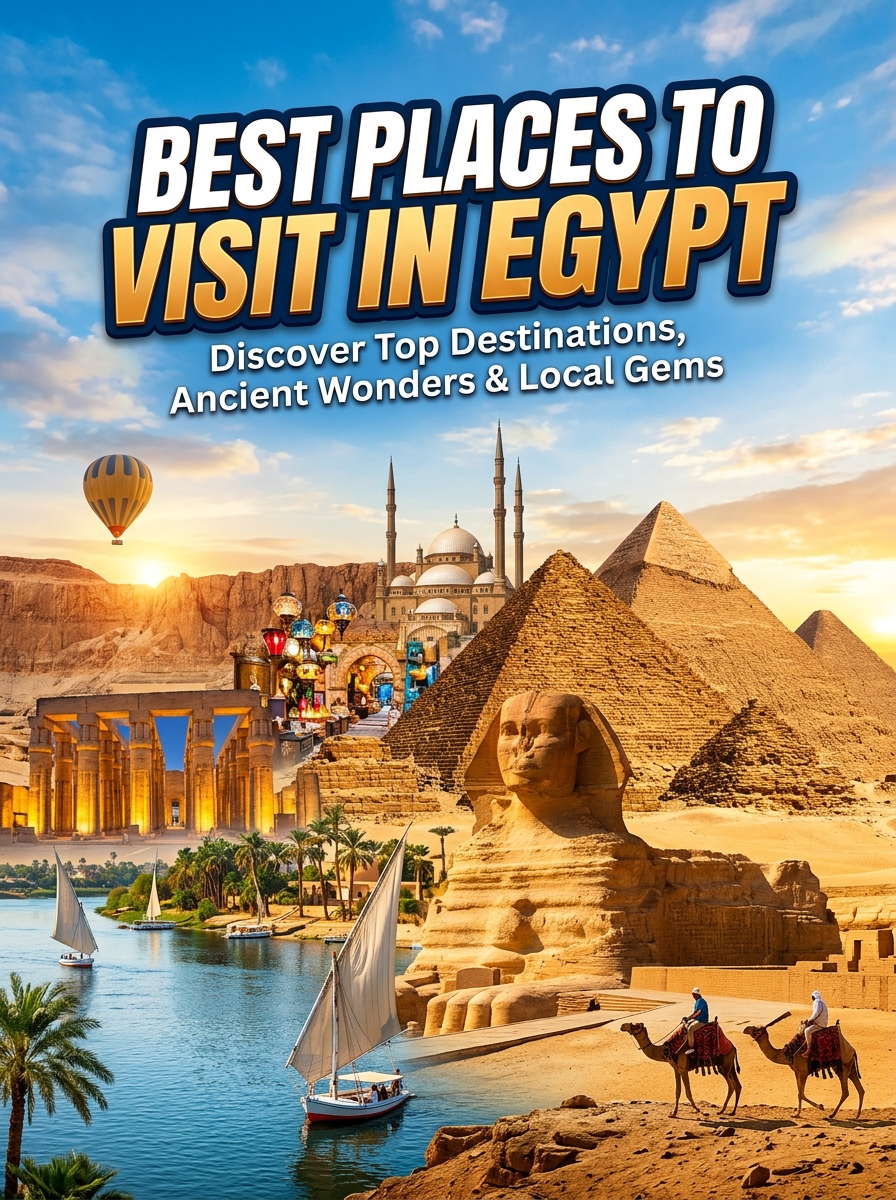
Egypt does something that almost no other country can. In a single ten-day trip you can stand at the last surviving wonder of the ancient world, sail between 3,000-year-old temples on the Nile, float in a desert salt lake that looks nothing like Africa or the Middle East, and eat grilled fish on the Red Sea with a coral reef 20 feet below you.
Most guides give you a list. This one gives you the context to use it. What each place actually delivers, how long it actually takes, and the things most articles skip.
Quick Answer: Best Places to Visit in Egypt
For a first visit, the core circuit is Cairo and Giza, Luxor, and Aswan, with Abu Simbel as a day trip from Aswan. A Nile cruise between Luxor and Aswan covers several of the best temple sites while moving between the two cities. Add the Red Sea coast for a beach break and the trip covers everything Egypt is most known for.
For more time or a second visit, Siwa Oasis, the White Desert, and the temples of Dendera and Abydos add a completely different dimension.
What Is New in 2026: The Grand Egyptian Museum
Before getting into destinations, one significant update: the Grand Egyptian Museum officially opened to the public on November 1, 2025, making 2026 its first full year of operation.
Located two kilometres from the Giza Pyramids, the GEM now holds the complete Tutankhamun collection, over 5,000 artifacts including his golden death mask, in a purpose-built climate-controlled space. TIME Magazine named it one of the World’s Greatest Places of 2026. For anyone who visited Egypt before 2025, the GEM represents a genuinely new experience and replaces the older Egyptian Museum in Tahrir as the primary museum destination in Cairo.
Cairo and Giza: Where Almost Every Egypt Trip Begins
The Pyramids of Giza and the Sphinx
The Pyramids of Giza are the only surviving wonder of the ancient world and the most visited site in Egypt for good reason. Standing at the base of the Great Pyramid of Khufu, which stands 139 metres tall and was the tallest structure on Earth for nearly 4,000 years, is genuinely one of those experiences where photographs fail entirely.
Most visitors arrive in the morning and stay two to three hours. This is not enough time. Give the plateau a full half-day. The three main pyramids, the smaller queens’ pyramids, the Sphinx complex, and the Solar Boat Museum together deserve at least four hours.
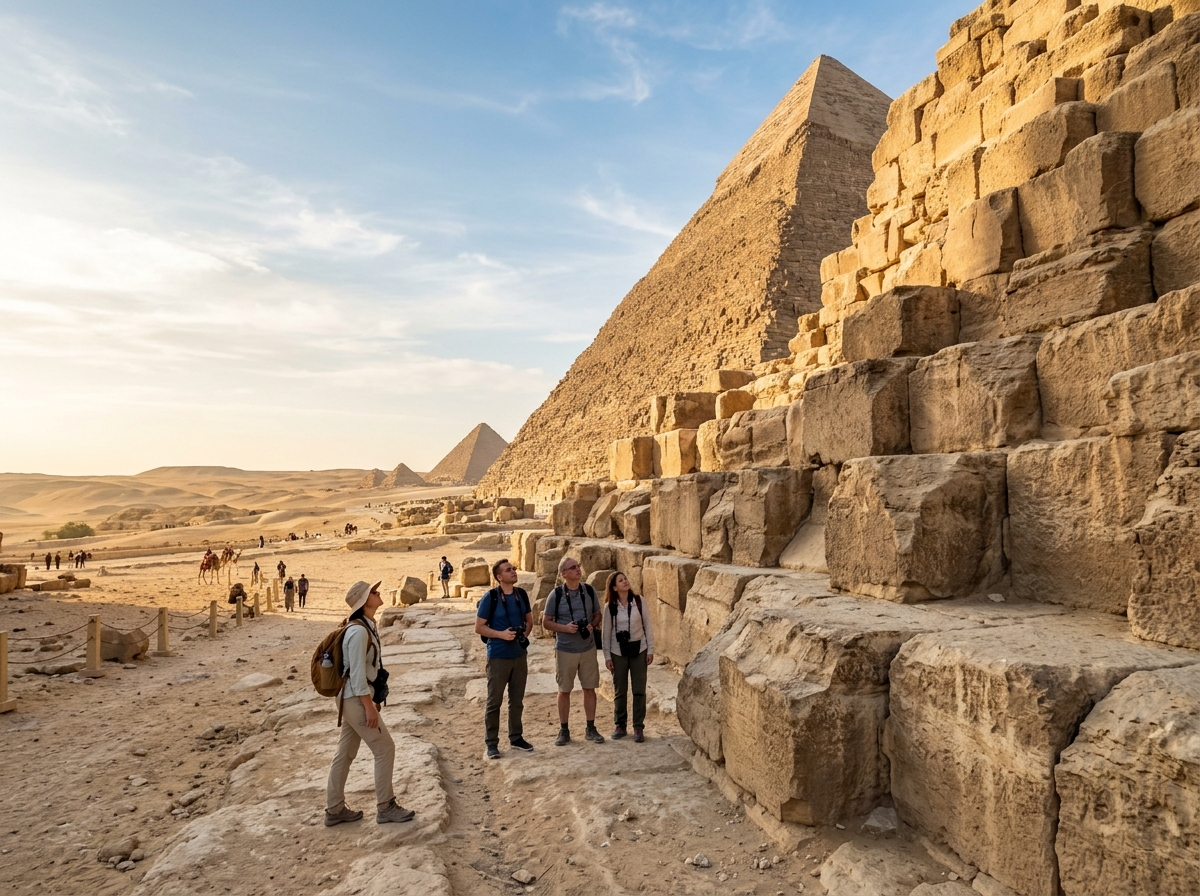
Practical tip: A guide is strongly recommended here. The site is large, the history is dense, and without context the pyramids can feel like large stones. With an Egyptologist guide, the scale and precision of what you are looking at becomes genuinely overwhelming in the best way.
The Grand Egyptian Museum (GEM)
For most of modern history, Egyptian artifacts were scattered across the old Cairo Museum in Tahrir and various storerooms. The GEM changes that permanently. The Tutankhamun galleries alone contain pieces that were previously in storage for decades.
Allow at least three to four hours. Book tickets in advance as demand is high in 2026, its first full year.
Islamic Cairo: The Khan el-Khalili Bazaar and the Citadel
Old Cairo contains layers of history that very few visitors actually reach because the Pyramids consume the day. The Saladin Citadel, a medieval Islamic fortress completed in 1183 AD overlooking the city, gives the best panoramic view of Cairo and houses two mosques worth visiting in their own right. Khan el-Khalili, the historic bazaar district beside the Al-Azhar Mosque, has been a trading hub since the 14th century. It is crowded, atmospheric, and excellent for Egyptian handicrafts, spices, and the particular chaos of old Cairo at its most alive.
A quality insect repellent and hand wipes are worth packing from home for any Cairo street exploration. The Sawyer Products SP657 Premium Picaridin Insect Repellent (available on Amazon) is DEET-free, long-lasting, and gentle on skin and fabric, making it suitable for both outdoor sightseeing and evenings at outdoor restaurants.

Picaridin Insect Repellent
Luxor: The World’s Greatest Open-Air Museum
Luxor sits roughly 670 kilometres south of Cairo on the Nile and was known in ancient times as Thebes, capital of the New Kingdom of Egypt during its most powerful centuries. The concentration of temples and tombs here is unmatched anywhere on Earth.
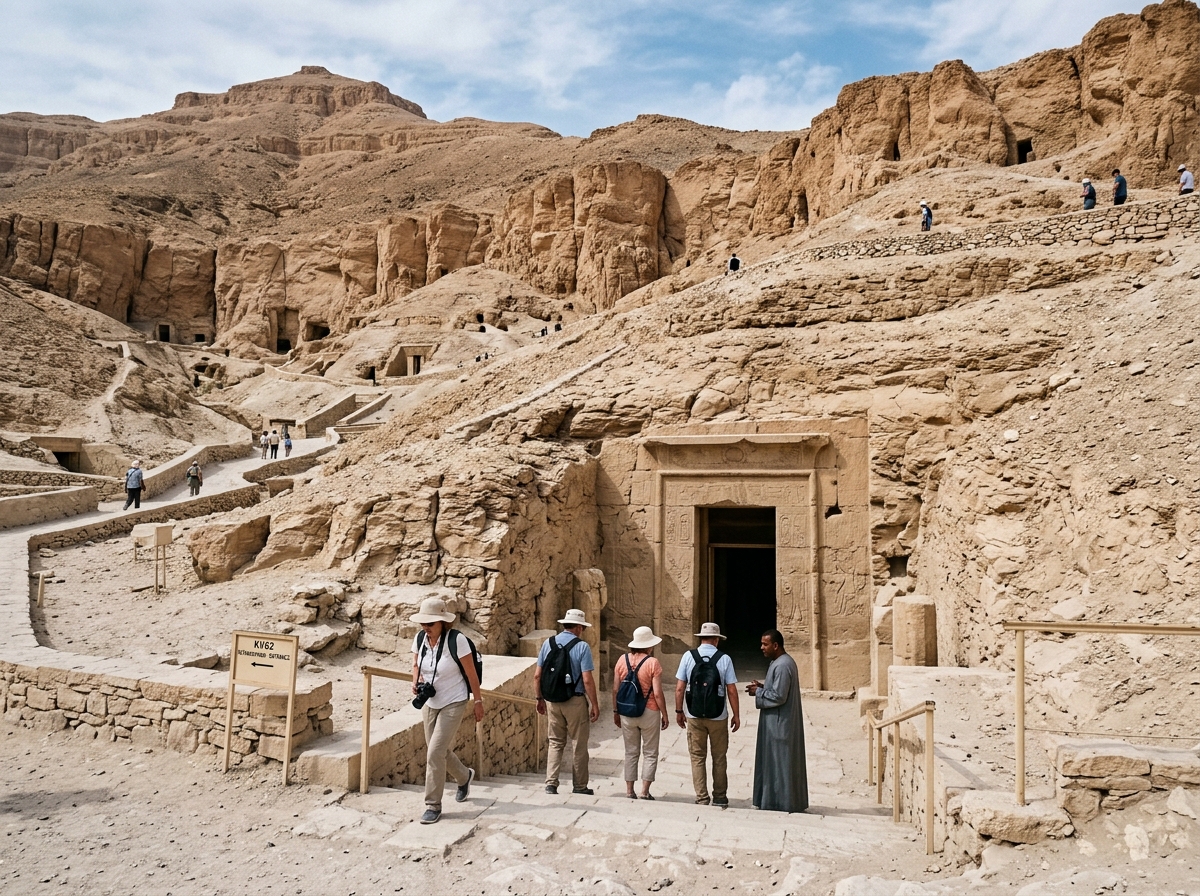
Valley of the Kings
The Valley of the Kings is a dry desert ravine on the West Bank of the Nile opposite Luxor where pharaohs of the New Kingdom, including Ramesses II and Tutankhamun, were buried in elaborate rock-cut tombs. Over 60 tombs have been discovered. The standard ticket includes entry to three tombs chosen from a rotating selection. Tutankhamun’s tomb and the tombs of Seti I and Ramesses VI require separate additional tickets.
Go in the morning. By midday the valley is very hot and crowded with tour groups. The tombs themselves are underground and cooler, but the walk between them is exposed.
Karnak Temple Complex
Karnak is the largest ancient religious site in the world. The Great Hypostyle Hall alone, a forest of 134 massive stone columns, each carved with hieroglyphs over their entire surface, is one of the most extraordinary human-made spaces that exists anywhere on Earth. Construction began around 2055 BC and continued for over 2,000 years across successive pharaohs, each adding their own sections.
Most visitors spend two hours at Karnak. Three is better.
Luxor Temple
Luxor Temple sits right in the city centre, lit up dramatically at night and open for evening visits. The contrast of the temple floodlit against a modern city street is uniquely Luxor and worth an evening walk even if you have already done a daytime visit.
Dendera and Abydos: The Overlooked Temples
These two sites, a day trip from Luxor, are among the least crowded and most extraordinary temples in Egypt.
Dendera is the Temple of Hathor, one of the best-preserved temple complexes in Egypt. The ceiling paintings, including the famous Dendera Zodiac, are in exceptional condition. The roof of the temple offers views across the surrounding desert that are unlike anything inside the Valley of the Kings.
Abydos is one of Egypt’s oldest cities and the site of the Temple of Seti I, known for some of the finest carved reliefs in ancient Egyptian art. The Abydos King List on one wall records 76 pharaohs in sequence and is one of the most important historical documents of the ancient world, carved into stone.
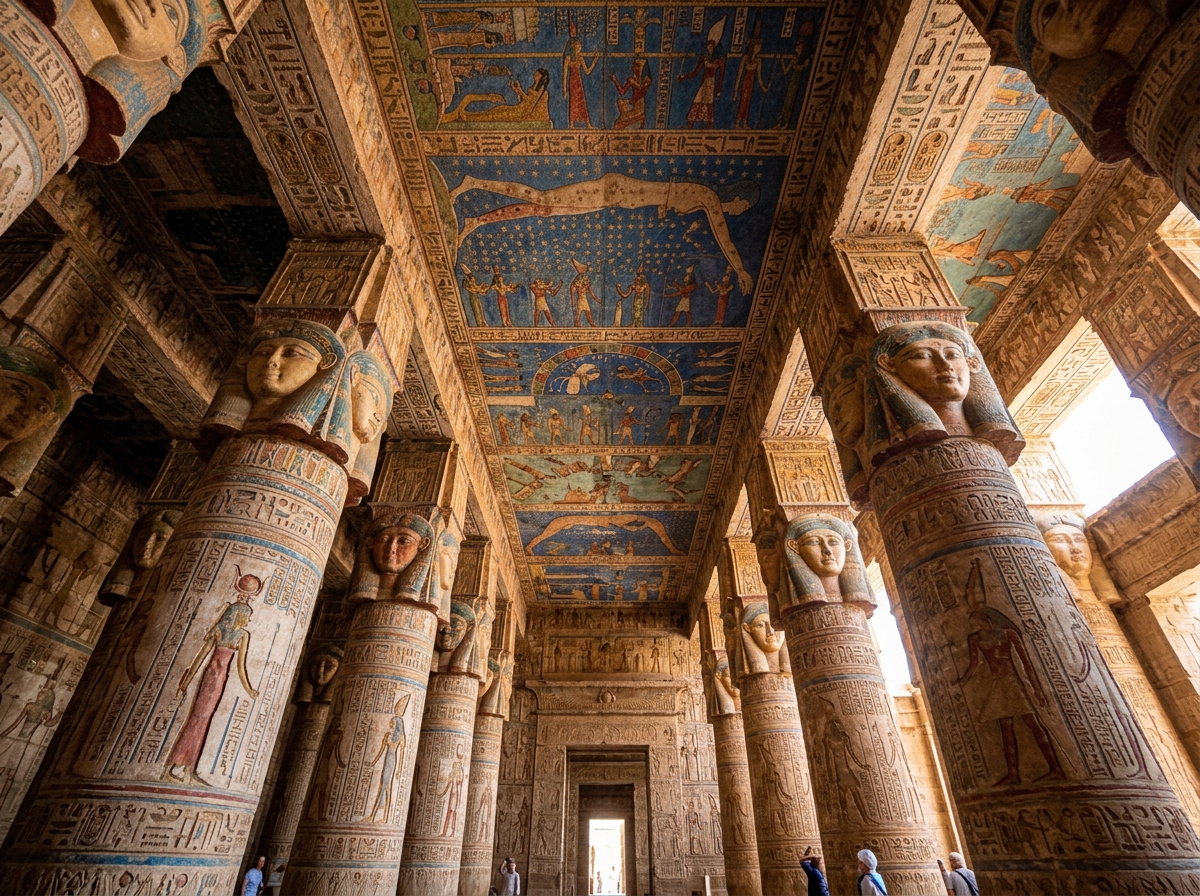
Both Dendera and Abydos together make one full day trip. Crowds at both are a fraction of Karnak or the Valley of the Kings.
Aswan: The Most Relaxed City in Egypt
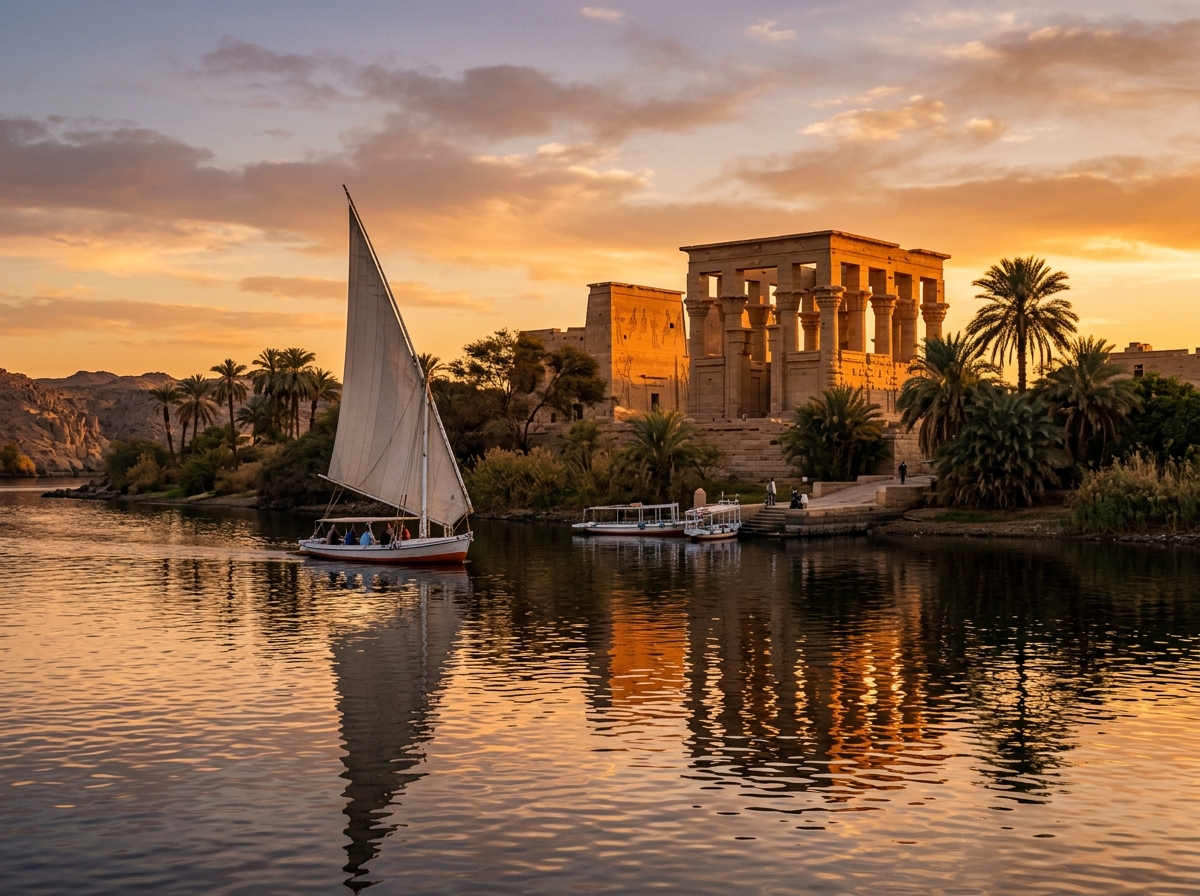
Aswan sits further south along the Nile toward Sudan and has a completely different atmosphere from Cairo or Luxor. The pace is slower, the Nubian cultural influence is stronger, and the Nile here looks the way it looks in paintings, with felucca sailing boats drifting between palm-covered islands in the afternoon light.
Philae Temple
Philae is an island temple dedicated to the goddess Isis, relocated stone by stone in the 1960s and 1970s to save it from flooding after the construction of the Aswan High Dam. You reach it by short boat ride from the Nile bank. The sound and light show in the evenings is atmospheric and one of the better such shows in Egypt.
The Philae Temple was the site of the last known hieroglyphic inscription in history, carved in 394 AD, making it symbolically the final chapter of ancient Egyptian civilization.
Nubian Villages
The villages on the banks and islands around Aswan have a distinct Nubian culture with brightly coloured houses, specific crafts, and a warmth toward visitors that many travellers describe as the most memorable human interaction of their Egypt trip. An afternoon in a Nubian village by felucca is time genuinely well spent.
Unfinished Obelisk
The quarries near Aswan were the source of much of ancient Egypt’s granite, and the Unfinished Obelisk, abandoned in situ when a crack appeared during quarrying, shows exactly how these massive structures were created. If you have ever wondered how the ancients moved 400-ton stones, standing beside an obelisk still attached to its rock foundation gives you a clearer picture than any museum display.
Abu Simbel: The Most Dramatic Temple in Egypt
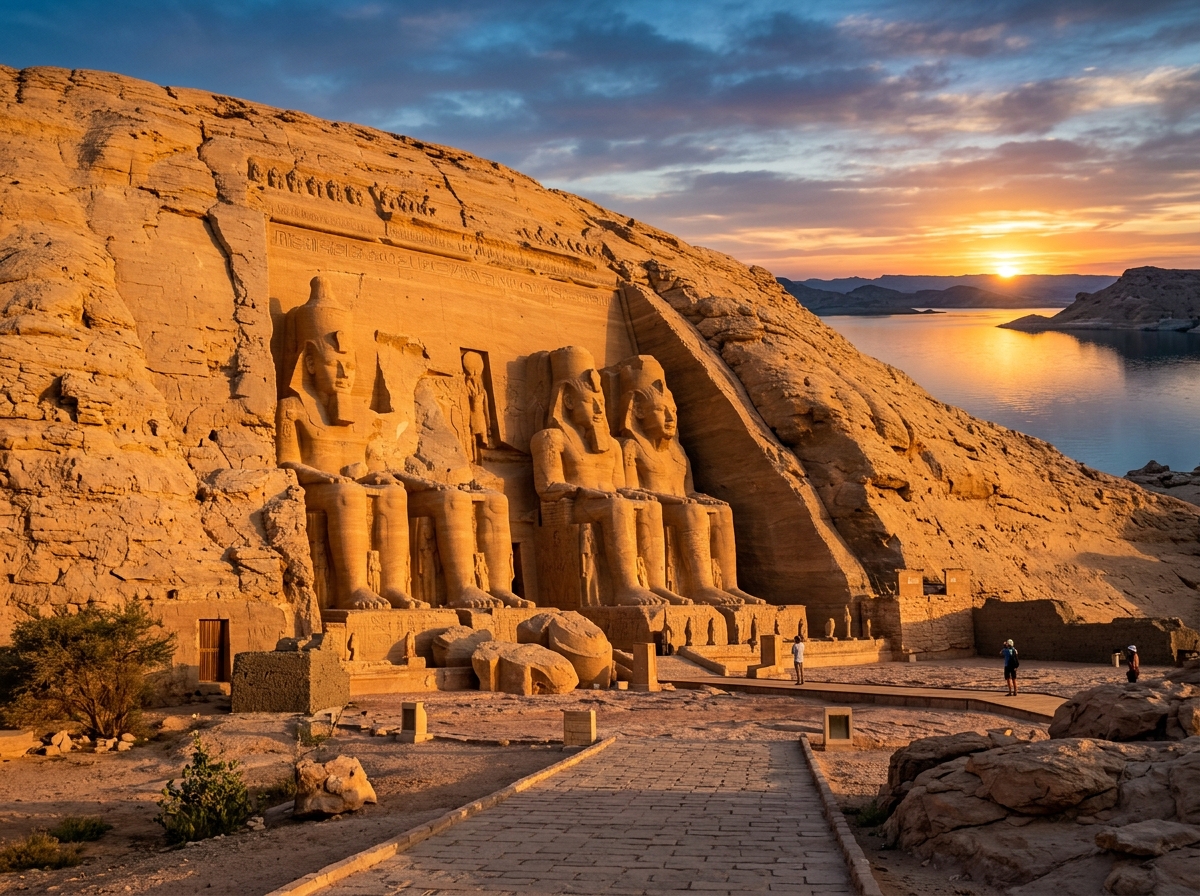
Abu Simbel sits 230 kilometres south of Aswan in the Nubian desert, right on the border with Sudan. Four colossal statues of Ramesses II, each over 20 metres tall, guard the entrance to a cliff-cut temple that was constructed around 1264 BC.
The entire complex was relocated stone by stone, and then reassembled 65 metres higher and 200 metres inland, between 1964 and 1968 to save it from flooding from the Aswan High Dam. It was one of the largest and most expensive archaeological salvage operations in history.
The Sun Festival: Twice a year, on February 22 and October 22, the first rays of sunrise penetrate the entire depth of the temple and illuminate three of the four statues at the innermost sanctuary. These dates draw visitors from around the world. The February 22 alignment marks what is believed to have been the anniversary of Ramesses II’s coronation.
Getting there: Most visitors fly from Cairo or Aswan (45 minutes) or join a guided road trip from Aswan (3 to 4 hours each way). The early morning road convoy from Aswan is the most affordable option, though the flight gives you more time at the site itself.
The Nile Cruise: One of Egypt’s Best Experiences
A cruise between Luxor and Aswan covers the stretch of the Nile with the highest density of ancient temples. The standard route takes three to four nights and stops at Edfu (Temple of Horus, one of the best-preserved temples in Egypt), Kom Ombo (a unique double temple dedicated to two gods), and several smaller sites.
There are two very different cruise experiences:
Large cruise ships carry hundreds of passengers and run on fixed schedules. They are efficient for seeing the major sites and tend to be comfortable and affordable.
Dahabiya boats are small traditional sailing vessels carrying typically 8 to 16 passengers. They move at the pace of the wind, stop at smaller temples and villages that larger boats cannot reach, and offer a genuinely intimate experience of the Nile. A dahabiya cruise costs significantly more than a standard cruise but is frequently described by those who have done both as one of the best travel experiences they have ever had.
For packing for a combined Egypt trip covering temples, desert, and a Nile cruise, a lightweight packable travel organizer keeps essentials sorted across the variety of accommodation types Egypt trips typically involve. The Eagle Creek Pack-It Specter Tech Cube Set (available on Amazon) is a lightweight, water-resistant set of packing cubes that compresses clothing efficiently for flights and keeps suitcase contents organized whether you are moving between Cairo hotels and a Nile cruise cabin.
The Red Sea Coast: Egypt’s Beach Destination
Hurghada
Hurghada is Egypt’s largest Red Sea resort town, with water sports, coral reefs, and all-inclusive hotels that attract primarily European visitors. It is the most accessible Red Sea destination from Cairo by domestic flight and is ideal for a few days of beach and snorkelling after the intensity of Cairo, Luxor, and Aswan.
Sharm El Sheikh
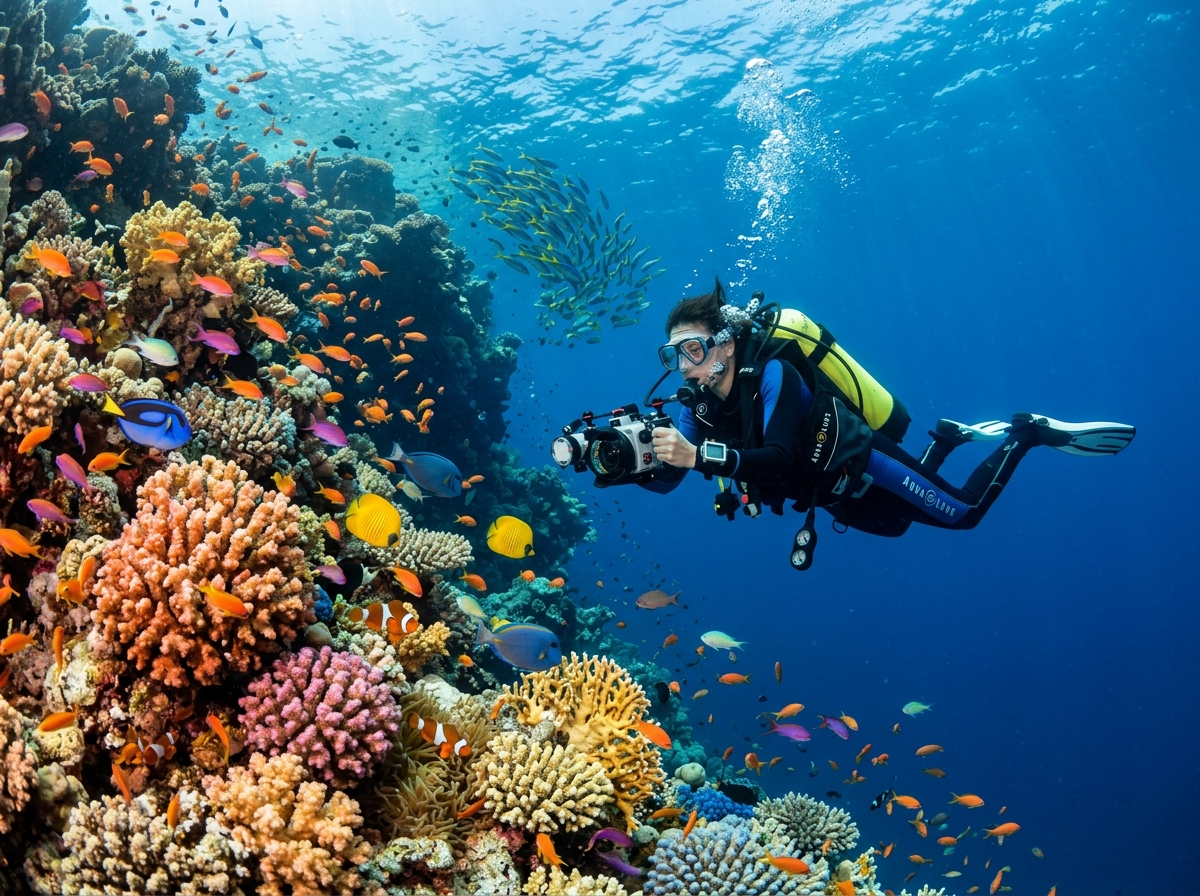
Sharm El Sheikh sits at the southern tip of the Sinai Peninsula and has some of the finest coral reef diving in the world. Ras Mohammed National Park, immediately outside the city, is protected and regularly cited as one of the best diving sites in the Red Sea. Windsurfing, kitesurfing, and glass-bottom boat tours are all available for non-divers.
Note: Sinai’s northern region near the border with Gaza is currently under advisory by several government travel departments. Tourist corridors of Sharm El Sheikh and the southern Sinai are considered safe and heavily monitored. Always check your government’s current travel advisory before visiting any part of Sinai.
Dahab
Dahab is a smaller, more laid-back alternative to Sharm El Sheikh with a backpacker-friendly culture, excellent snorkelling from the beach, and the famous Blue Hole, a circular reef formation considered one of the most spectacular dive sites in the world. It is also significantly more affordable than Sharm El Sheikh.
Marsa Alam
Further south along the Red Sea coast, Marsa Alam is emerging as the destination for serious divers seeking less crowded reefs and encounters with dugongs, manta rays, and whale sharks during their seasonal visits.
Hidden Gems: Beyond the Standard Circuit
Siwa Oasis
Siwa sits in the Western Desert 560 kilometres west of Cairo, near the Libyan border. It is one of the most isolated and atmospheric places in Egypt, with a distinct Berber culture, unique mud-brick architecture, natural spring-fed pools, and salt lakes where you can float the way you would in the Dead Sea.
The Temple of the Oracle at Siwa is where Alexander the Great came in 331 BC to consult the famous oracle and was reportedly proclaimed a son of the god Amun. The ruins stand at the edge of the oasis in the late afternoon light.
Siwa requires three to five days to appreciate properly. Getting there typically means a long bus journey or private car from Cairo, or a connection via Marsa Matruh on the Mediterranean coast.
The White Desert
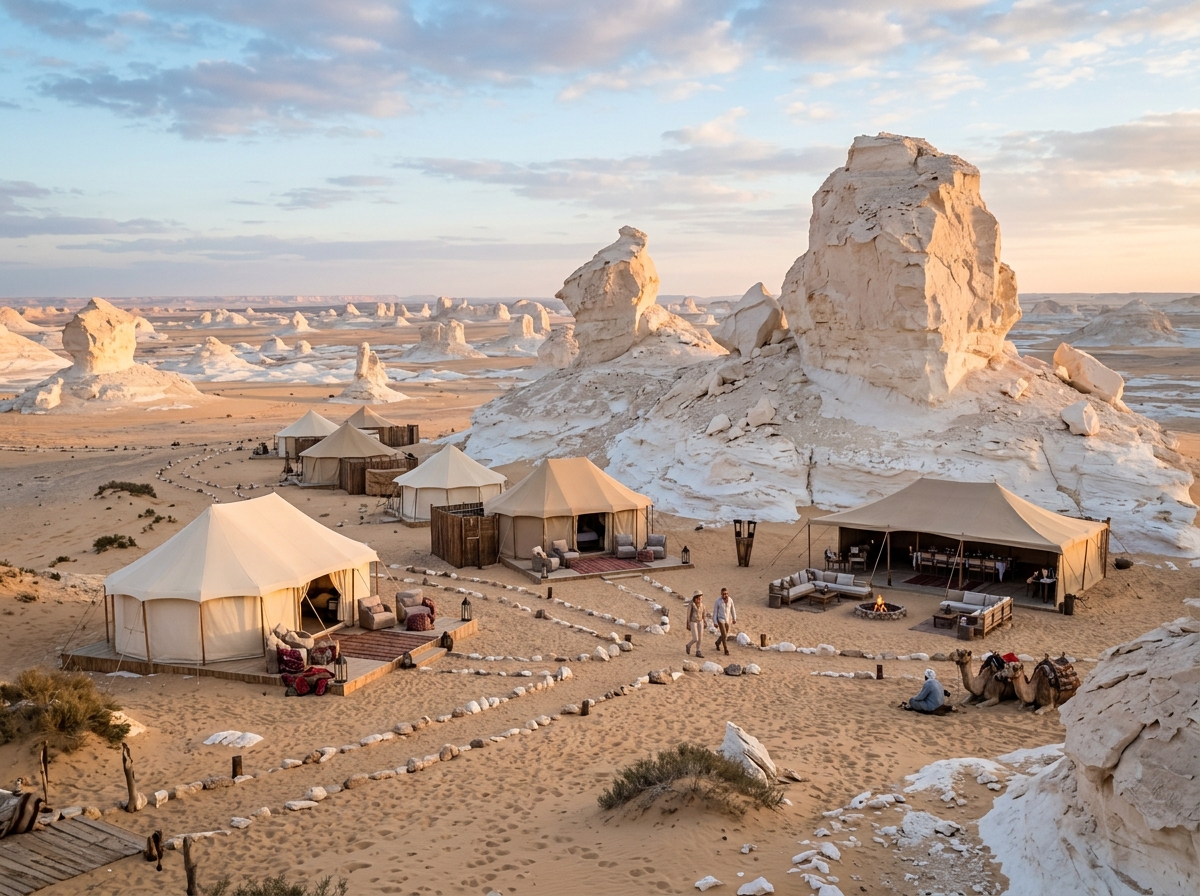
The White Desert, around five hours from Cairo near the Bahariya Oasis, is a surreal landscape of wind-eroded chalk formations rising from golden sand in shapes that look like abstract sculptures, mushrooms, and ghostly figures. Camping overnight under an extraordinary dark sky is one of the most unusual experiences available within Egypt.
The Black Desert nearby, with its volcanic rock-strewn landscape, provides dramatic contrast when visited as part of the same desert circuit.
Wadi El-Hitan
Wadi El-Hitan, known as the Valley of the Whales, is a UNESCO World Heritage Site in the Fayoum region southwest of Cairo. The desert floor is scattered with the fossilized skeletons of ancient whales that swam here when the area was an ancient sea 40 million years ago. The setting, large whale skeletons visible in open desert, is genuinely surreal and gives Egypt a dimension that the ancient civilization emphasis usually obscures.
Practical Tips for Visiting Egypt
Best time to visit: October through April for the desert and ancient sites, when temperatures are 20 to 25 degrees Celsius rather than the 40-plus degrees of summer. The Red Sea coast is excellent year-round due to consistent water temperatures. Summer visits to Luxor and Aswan are possible but require early morning starts and midday air-conditioning.
Safety: Tourist areas in Egypt, including Cairo, Giza, Luxor, Aswan, Hurghada, Sharm El Sheikh, Dahab, and Siwa, are heavily monitored by dedicated tourism police and are considered safe. Egypt recorded over 8.9 million tourist visits in 2025 with a 99.97% incident-free rate. North Sinai near the border with Gaza is under official avoidance advisories from multiple governments and should not be visited. The area within 50 kilometres of the Libyan border is also subject to advisories; Siwa itself sits close to this zone, so check your government’s specific guidance before booking.
Dress code: Egypt is a predominantly Muslim country and modest dress is appropriate everywhere outside beach resorts. Covering shoulders and knees for temple and mosque visits is required. Women do not need to cover their hair in most places, though a light scarf is useful in very conservative areas and in some mosques.
Money: The Egyptian pound is the currency. ATMs in major tourist areas are generally reliable. Cash is useful for smaller vendors, transport, and tips. Tipping (baksheesh) is culturally expected in Egypt for most services and a small amount goes a significant way.
Guided tours vs independent travel: Egypt is one of the destinations where a guided tour genuinely adds value beyond convenience. Egyptologist guides provide historical context that transforms what you see. Many travelers combine a guided tour for major ancient sites with independent time in cities and beach destinations.
A good travel neck wallet keeps passport, cards, and cash secure beneath clothing in Cairo markets and on Nile boats where pocket-picking can occur. The Lewis N. Clark Comfort Neck Stash (available on Amazon) sits flat under a shirt, holds a passport and cards without visible bulk, and is widely recommended for Egypt travel specifically because of the bazaar environment in Khan el-Khalili and other crowded sites.

Stash Neck Wallet
Best Places in Egypt by Traveller Type
First-time visitors: Cairo and Giza, Luxor, Aswan, Abu Simbel, and a Red Sea stop. A 10-day itinerary covers this at a reasonable pace.
History and archaeology: Add Dendera and Abydos to the Luxor itinerary, budget extra time at the GEM in Cairo, and consider the Western Oases for pre-pharaonic and classical-era sites.
Beach and diving: Red Sea coast, Hurghada for accessibility and families, Sharm El Sheikh and Dahab for diving quality, Marsa Alam for serious divers and whale shark encounters.
Desert and adventure: Siwa Oasis, White Desert, Wadi El-Hitan, Black Desert, and sandboarding at Fayoum.
Budget travellers: Egypt is affordable relative to most international destinations. A daily budget of $50 to $80 covers good guesthouses, local food, and entrance fees comfortably. Nile cruises on smaller boats are available at various price points, and the overnight train from Cairo to Luxor is one of the best budget options for covering distance.
Quick Reference Table
| Destination | Region | Best For | Best Season | Drive or Flight from Cairo |
|---|---|---|---|---|
| Giza Pyramids and GEM | Greater Cairo | Essential first stop | Oct to Apr | On-site |
| Luxor | Upper Egypt | Temples and tombs | Oct to Apr | 1hr flight or 9hr train |
| Valley of the Kings | Luxor West Bank | Ancient tombs | Oct to Apr | Day trip from Luxor |
| Karnak Temple | Luxor | Largest temple complex | Oct to Apr | Luxor city |
| Aswan | Upper Egypt | Nubian culture, felucca | Oct to Apr | 1hr flight from Luxor |
| Abu Simbel | Southern Egypt | Colossal temples | Oct to Apr | 45min flight from Aswan |
| Nile Cruise | Luxor to Aswan | River temples and scenery | Oct to Apr | Between Luxor and Aswan |
| Hurghada | Red Sea Coast | Beaches, snorkelling, families | Year-round | 1hr flight from Cairo |
| Sharm El Sheikh | Sinai Peninsula | Diving, coral reefs | Year-round | 1.5hr flight from Cairo |
| Siwa Oasis | Western Desert | Desert, Berber culture | Oct to Apr | 8hr drive from Cairo |
| White Desert | Western Desert | Surreal landscape, camping | Oct to Apr | 5hr drive from Cairo |
Frequently Asked Questions
What is the most beautiful place in Egypt?
Most visitors name Abu Simbel as the single most visually extraordinary site in Egypt, particularly at sunrise when the colossal Ramesses statues glow in the early light against the Nubian desert. Karnak Temple’s Hypostyle Hall and the view of Philae Temple from the water are close competitors for sheer emotional impact.
How many days do you need in Egypt?
Seven to ten days covers the essential circuit of Cairo, Luxor, Aswan, and a Red Sea stop. Ten to fourteen days allows for a Nile cruise, Abu Simbel, and a desert excursion. The Western Oases (Siwa, White Desert) realistically require an additional three to five days as a separate add-on.
Is Egypt safe to visit in 2026?
Tourist areas are safe and heavily monitored. Egypt recorded over 8.9 million tourist visits in 2025 with a 99.97% incident-free rate. North Sinai near the Gaza border and areas within 50 kilometres of the Libyan border carry official advisories. All mainstream tourist destinations, including Cairo, Giza, Luxor, Aswan, the Red Sea coast, and Siwa, are considered safe for visitors.
What is the best way to travel between Luxor and Aswan?
A Nile cruise is the most atmospheric option, covering the distance while stopping at several temple sites. The overnight sleeper train between Cairo and Luxor or Aswan is a budget-friendly alternative with good passenger compartments. Domestic flights are the fastest option and affordable when booked in advance.
Do I need a visa to visit Egypt?
Most nationalities require a visa. Egypt operates an e-visa system available online before travel, which is significantly faster and easier than obtaining a visa on arrival. Check the Egyptian Ministry of Interior’s official portal for your specific nationality.
What should I eat in Egypt?
Koshari, a layered street food dish of rice, lentils, pasta, chickpeas, and spiced tomato sauce, is Egypt’s most beloved national dish and costs almost nothing from street vendors. Ful medames, slow-cooked broad beans with olive oil and spices, is the standard Egyptian breakfast. Fresh bread from neighbourhood bakeries is extraordinary. Red Sea seafood in Hurghada or Dahab is excellent and affordable.
What is the Sun Festival at Abu Simbel?
The Sun Festival occurs on February 22 and October 22 each year, when the first rays of sunrise penetrate 65 metres into the inner sanctuary of the Abu Simbel temple and illuminate three of the four seated statues of Ramesses II and the sun gods. The fourth statue, of Ptah (god of the underworld), remains in darkness. These dates draw large crowds and require advance booking of Aswan accommodation.
Final Thoughts
Egypt is one of the very few places where the reality genuinely exceeds the expectation. The Pyramids look exactly like photographs and somehow still stop you in your tracks. Karnak is bigger and more overwhelming in person than any image conveys. The Nile at sunset from a felucca boat is as peaceful as anything in travel.
The best thing you can do for an Egypt trip is give it more time than feels necessary and resist the urge to rush through every site on the list. The temples, the desert, the river, and the people all reward the traveller who slows down and pays attention.
Plan well, dress modestly, tip generously, and start every major site visit before 9am. Egypt will handle the rest.