Where you stay in Atlanta matters more than in most American cities.
Atlanta is not a walking city by default. It is a car-dependent metro spread across hundreds of square miles, with distinct pockets of walkability separated by highways and sprawl. Staying in the right neighbourhood means stepping out to good restaurants, being near what you came to see, and not spending every evening fighting rush hour traffic on I-285.

This guide covers every major area clearly, by what it is actually like to stay there, not just what the hotel pictures show.
Quick Answer: Best Place to Stay in Atlanta
For most first-time visitors, Midtown is the strongest overall choice. It is the most walkable part of the city, close to major museums and Piedmont Park, on MARTA rail, and has the widest range of restaurants and bars within walking distance of most hotels.
For a more local, neighbourhood feel with excellent food access, Old Fourth Ward (O4W) near Ponce City Market is the most dynamic option in Atlanta right now. For luxury shopping and upscale accommodation, Buckhead. For attractions like the Georgia Aquarium and World of Coca-Cola, Downtown. For the best budget-to-value option near major highways, Atlantic Station and the Perimeter area.
Before You Choose: The One Decision That Changes Everything
Atlanta has a very different quality of life depending on whether you are near the Atlanta BeltLine or not.
The BeltLine is a 22-mile loop of converted railway corridors, now a paved multiuse trail connecting over 40 neighbourhoods with restaurants, bars, public art, and green space along the route. Staying within easy walking distance of the BeltLine, particularly the Eastside Trail that runs through Old Fourth Ward, Inman Park, Ponce City Market, and toward Piedmont Park, is the single variable that most determines how much of Atlanta you experience on foot.
If you are based somewhere with BeltLine access, you can walk or bike between restaurants, bars, and neighbourhood attractions. Without it, you need a car for almost everything after dark.
Midtown: Best Overall for First-Time Visitors
Midtown sits between Downtown and Buckhead along Peachtree Street and is the most balanced neighbourhood for visitors who want to be central, walkable, and on MARTA.
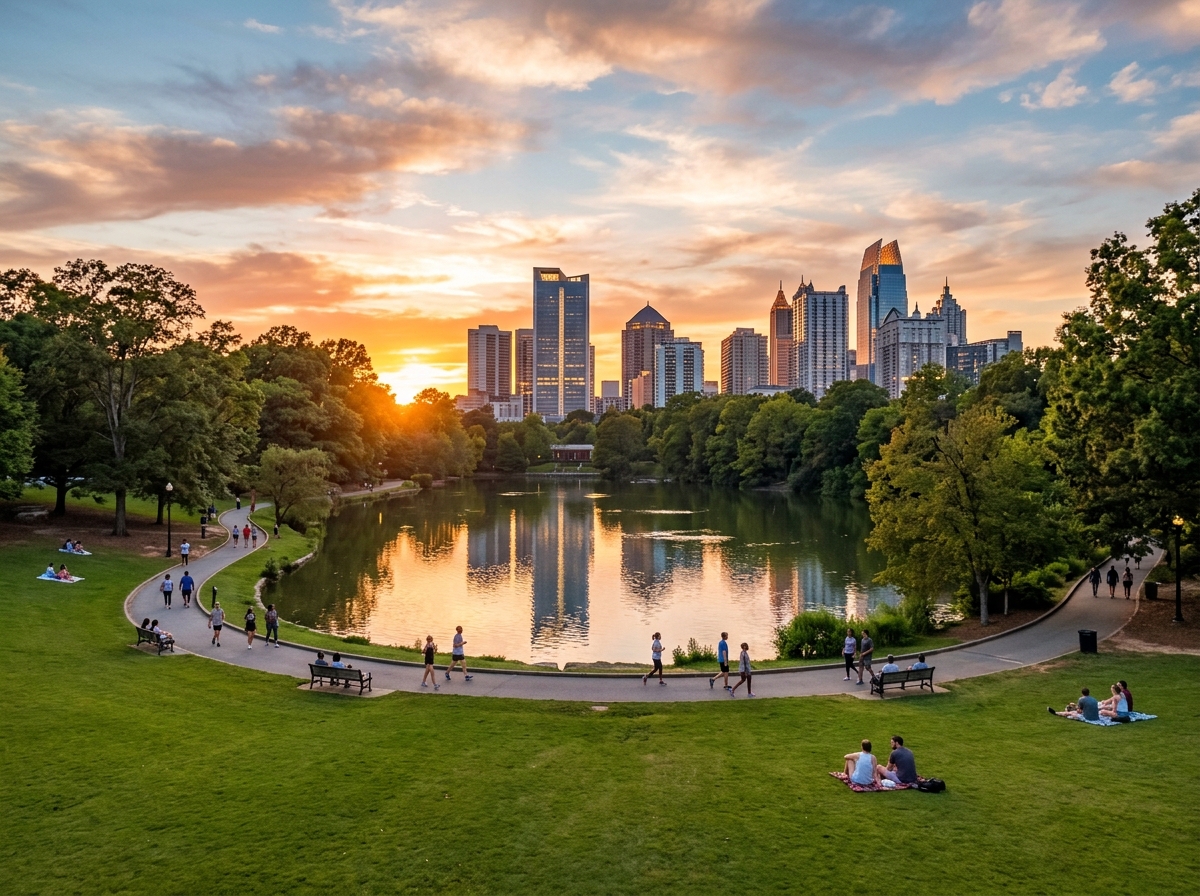
What you actually get: Midtown has the highest density of quality restaurants, bars, and cultural institutions per square mile in Atlanta. The High Museum of Art, the Atlanta Botanical Garden, and the Fox Theatre are all here. Piedmont Park, Atlanta’s version of Central Park, anchors the north end. The neighbourhood runs along Peachtree Street, which means restaurants and shops are genuinely walkable from most hotels.
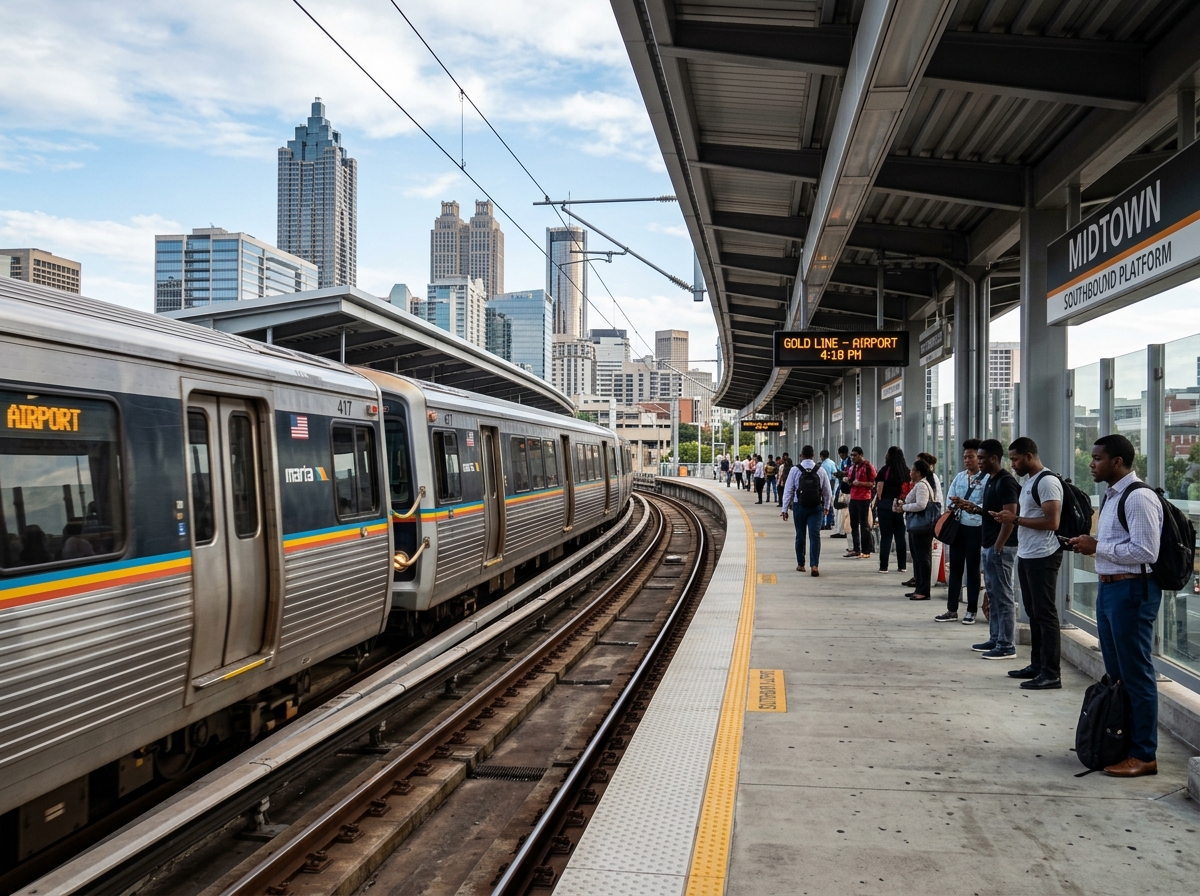
Transport: Three MARTA stations (North Avenue, Midtown, and Arts Center) put the whole rail system within reach. The airport is about 35 minutes by MARTA with no traffic. Downtown is 10 minutes by rail.
Best for: First-time visitors, business travellers, those who prioritise walkability, LGBTQ+ visitors (Midtown is Atlanta’s most established LGBTQ+ neighbourhood), anyone who wants to explore Atlanta without a car.
Honest trade-off: Midtown hotels are busy and pricey during convention season and major events. The Georgia World Congress Center draws large conferences that spike hotel prices city-wide, and Midtown feels particularly busy during these periods.
Hotels to know: The Loews Atlanta on Peachtree Street is consistently well-reviewed for its central Midtown location and walkability. The Ellis Hotel is a boutique property with strong reviews for rooms and service. The W Atlanta Midtown delivers style at a mid-luxury price point.
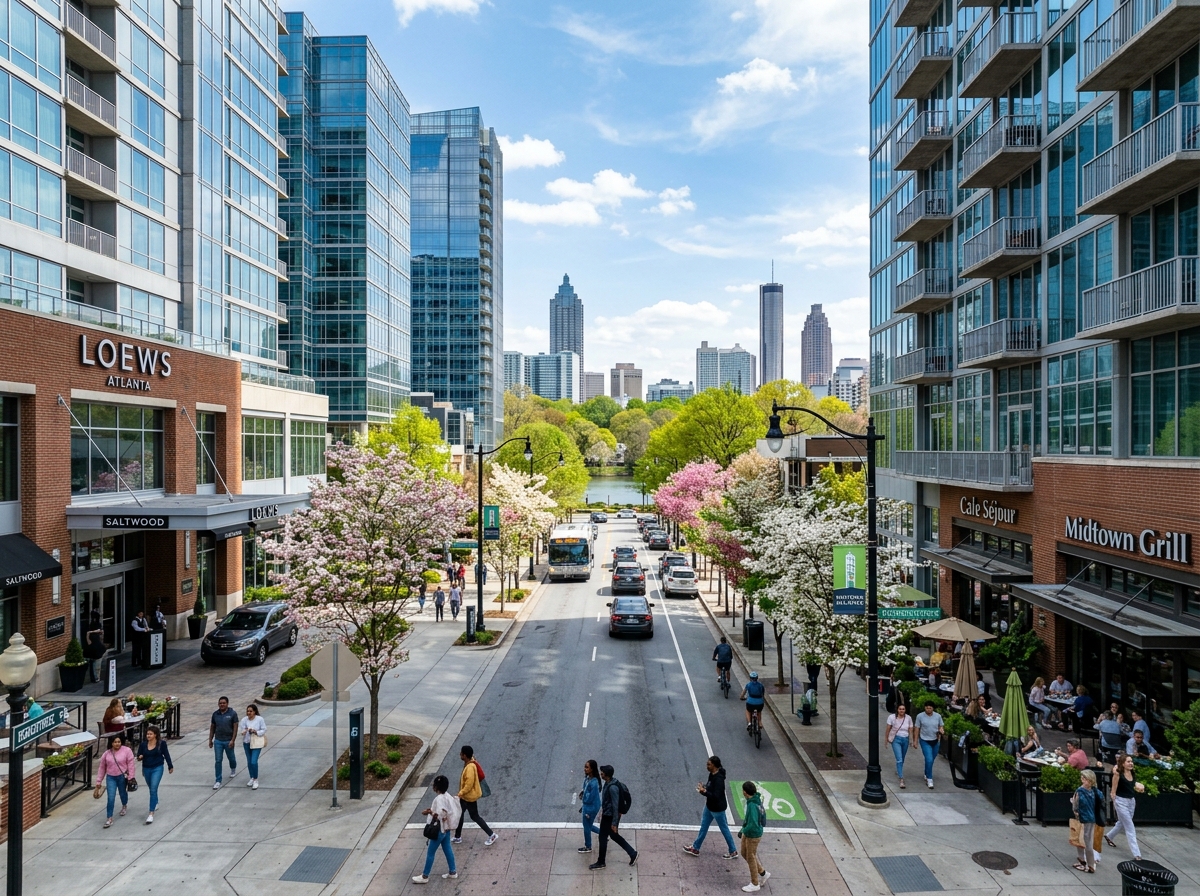
Price range: Midtown hotels typically run $150 to $350 per night for a standard room outside major event periods.
For any stay involving Midtown’s walkable streets, Piedmont Park, and the BeltLine trail system, comfortable footwear that handles both city pavement and the crushed granite BeltLine trail without fatigue matters. The Brooks Ghost Max Walking Shoe (available on Amazon) is the most recommended walking shoe for extended city days, with maximum cushioning that holds up through a full day of Atlanta sightseeing without leaving your feet feeling the mileage by evening.
Old Fourth Ward: Best for Food and BeltLine Culture
Old Fourth Ward (universally abbreviated as O4W) is the neighbourhood that most Atlantans recommend to visitors who want a more local experience than a Midtown chain hotel provides.
What you actually get: O4W has been transformed over the past decade from a neglected industrial area into one of Atlanta’s most vibrant neighbourhoods. The anchor is Ponce City Market, a massive converted Sears building on Ponce de Leon Avenue that now contains a food hall, boutique shops, tech offices, and a rooftop amusement park with genuinely excellent sunset views over the BeltLine and the city skyline.
The BeltLine Eastside Trail runs directly through Old Fourth Ward, connecting you on foot to Inman Park, Krog Street Market, Virginia-Highland, and north toward Midtown. The restaurant and bar scene along the trail and around PCM is excellent and genuinely varied.
The neighbourhood also borders Sweet Auburn, the historic district where Martin Luther King Jr. was born. The King Center and Birth Home are a 10-minute walk from most O4W accommodation.
Best for: Younger visitors, foodies, culture-seekers, BeltLine cyclists, people who want a boutique hotel or Airbnb experience over a large chain hotel.
Honest trade-off: Fewer large hotels than Midtown or Downtown. Most accommodation options are boutique properties, serviced apartments, or short-term rentals. The nearest MARTA station (Inman Park/Reynoldstown) is a short walk or rideshare away from most of the neighbourhood’s core.
Hotels to know: Ponce City Market’s Scout Living property has rooms that overlook the BeltLine and Ponce de Leon, which is genuinely appealing. The Graduate Atlanta is a design-forward boutique hotel popular with visitors who want more personality than a standard chain.
Price range: $130 to $280 per night for most properties.
Downtown Atlanta: Best for Major Attractions
Downtown Atlanta is where the big tourist draws concentrate, and it makes sense for visitors whose entire trip is built around those attractions.
What you actually get: Downtown holds the Georgia Aquarium (one of the largest in the world), the World of Coca-Cola, Centennial Olympic Park, CNN Center, Mercedes-Benz Stadium (Falcons and Atlanta United), and State Farm Arena (Hawks and major concerts). Walking between these attractions is genuinely practical from most Downtown hotels.
The Georgia World Congress Center is here, making Downtown the default for convention visitors. The Streetcar connects Downtown with Old Fourth Ward along Edgewood Avenue.
Best for: Convention visitors, families with children wanting aquarium and World of Coca-Cola access, sports fans attending games at Mercedes-Benz Stadium or State Farm Arena.
Honest trade-off: Downtown has improved significantly over the past decade but remains less vibrant in the evenings outside of event nights than Midtown or Old Fourth Ward. The restaurant scene is sparser and less exciting than in both neighbourhoods. Many visitors describe Downtown as “great during the day and quiet at night unless there is a game.”
Hotels to know: The Westin Peachtree Plaza, with its distinctive round tower and Sundial rotating restaurant at the top, is a Downtown landmark. The Omni Atlanta at CNN Center is directly connected to CNN Center and Centennial Olympic Park. The Glenn Hotel Autograph Collection is a boutique option that many visitors prefer to the larger chains.
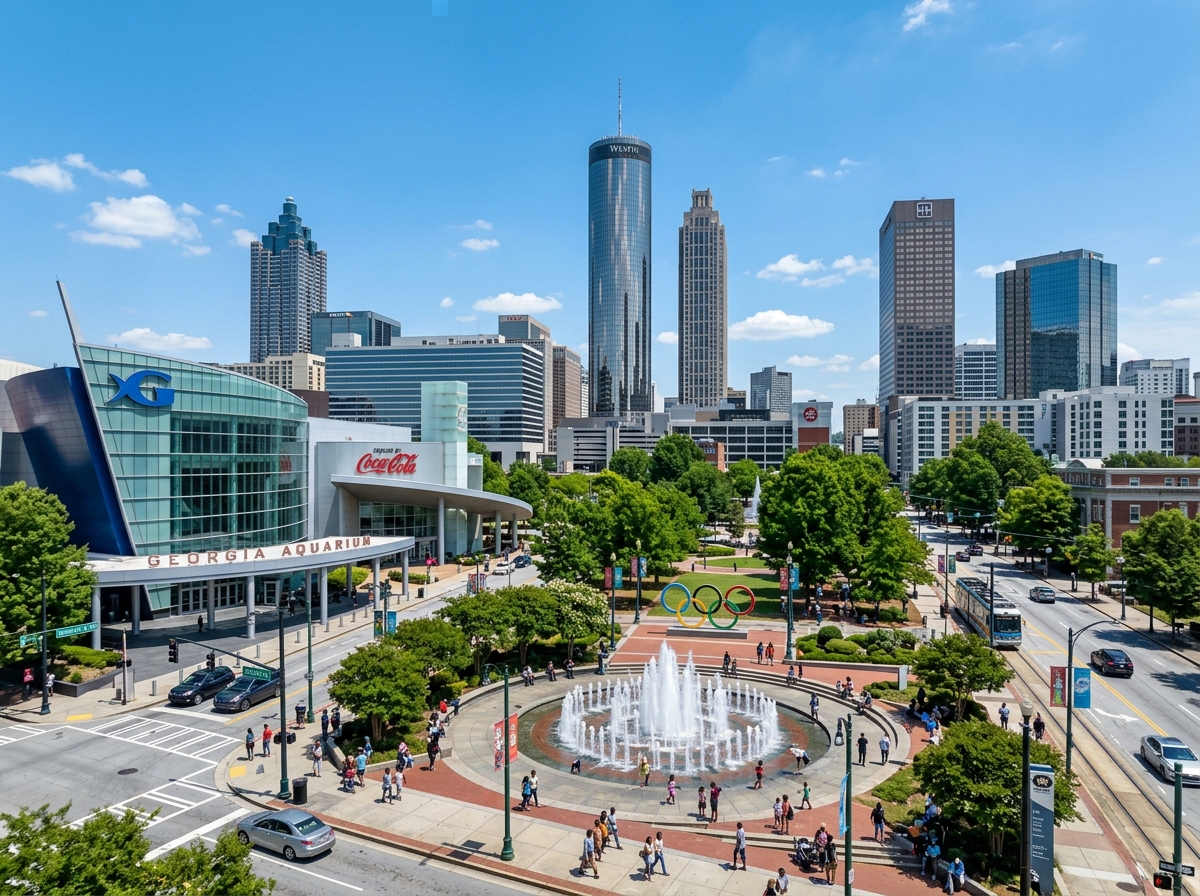
Price range: $120 to $300 per night, with significant spikes on major event nights.
Buckhead: Best for Luxury and Shopping
Buckhead sits north of Midtown and is Atlanta’s most affluent neighbourhood, with a concentration of upscale hotels, high-end shopping, and fine dining that competes with any neighbourhood in the South.
What you actually get: Lenox Square and Phipps Plaza are two of the Southeast’s premier shopping destinations, anchored by Neiman Marcus, Saks Fifth Avenue, and dozens of luxury retailers. The dining along Buckhead Village and the surrounding streets includes serious restaurant options at multiple price points.
The Atlanta History Center is in Buckhead and is one of the most significant history museums in the South, with extensive coverage of the Civil War and Atlanta’s history.
Three MARTA stations (Buckhead, Lenox, and Medical Center) give reasonable rail access without a car, though Buckhead is less walkable overall than Midtown because the distances between points of interest are greater.
Best for: Luxury travellers, business visitors in the financial district, shoppers, couples wanting upscale accommodation with restaurant access.
Honest trade-off: Buckhead is significantly less walkable day-to-day than Midtown or Old Fourth Ward. The distances between the hotels, the malls, and the restaurants generally require a car or rideshare. It is not the right neighbourhood for visitors who want to explore Atlanta on foot.
Hotels to know: The Four Seasons Hotel Atlanta in Midtown is technically on the border of Midtown and Buckhead and consistently rates as the finest hotel in the city. The Waldorf Astoria Atlanta Buckhead delivers the classic luxury hotel experience. The InterContinental Buckhead is popular with corporate travellers for its convenient location to the business district.
Price range: $180 to $600 per night at luxury properties.
Inman Park and Virginia-Highland: Best for Neighbourhood Character
These two adjacent neighbourhoods east of Old Fourth Ward are where Atlanta’s walkable, residential character is strongest. Both are BeltLine-adjacent and have the city’s best independent restaurant and bar scenes alongside genuine Victorian-era architecture.
What you actually get: Inman Park is the city’s first planned suburb, dating from 1890, with a concentration of restored Victorian mansions and bungalows on tree-lined streets. Krog Street Market, a smaller food hall than Ponce City Market but often cited as the better quality option, anchors the neighbourhood’s eating scene.
Virginia-Highland (called Va-Hi by locals) sits north of Inman Park and has the city’s best independent bar and restaurant strip along North Highland Avenue. The neighbourhood feels like a village within the city in a way that no other Atlanta neighbourhood quite replicates.
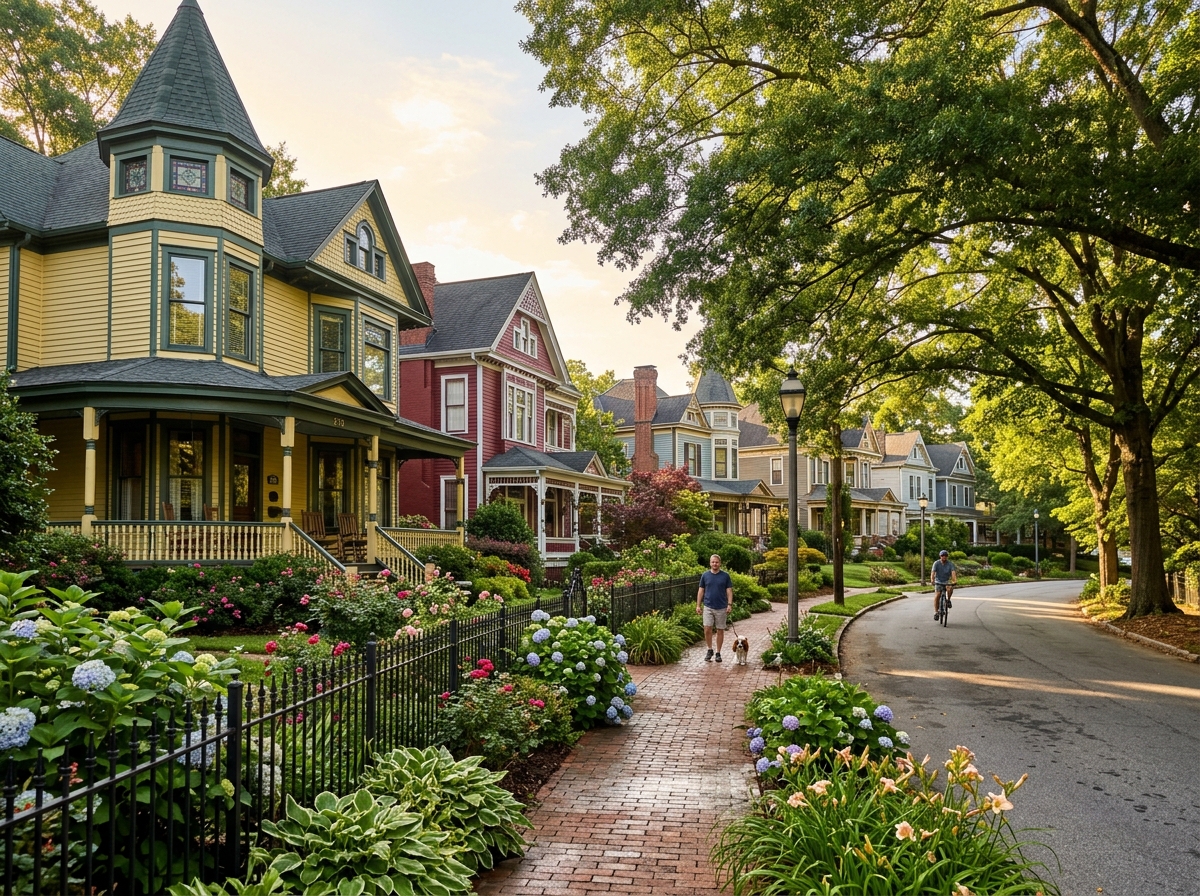
Best for: Visitors who want to experience Atlanta as locals do, particularly those interested in independent restaurants and the BeltLine. Short-term rentals and Airbnbs are the primary accommodation option here rather than hotels.
Honest trade-off: Very few hotels, almost no large chain options. This is a neighbourhood for Airbnb or boutique B and B stays. MARTA rail access requires a short rideshare or walk to stations.
Price range (Airbnb): $80 to $200 per night for a well-reviewed home or apartment.
For a multi-neighbourhood Atlanta trip involving Krog Street Market evenings, BeltLine mornings, and rideshare travel between areas, a compact anti-theft crossbody bag that keeps phone, wallet, and cards organised across all of these scenarios without bulk is genuinely useful. The Pacsafe Metrosafe LS100 Crossbody Bag (available on Amazon) has slash-resistant straps, RFID-blocking pockets, and locking zips in a compact design that works equally well at a Buckhead dinner and a BeltLine bar crawl.

Pacsafe V Tech Sling
Atlantic Station: Best for Easy Driving and Parking
Atlantic Station is a planned mixed-use development in the northwest part of Midtown, converted from an old steel mill site, with hotels, retail, restaurants, and a cinema within a walkable internal campus.
What you actually get: Atlantic Station is essentially a self-contained campus. The hotels, the shops, and the restaurants are within easy walking distance of each other within the development, and free shuttle service connects it to the Arts Center MARTA station. Outside the campus, you need a car.
It is not the most exciting neighbourhood base, but it is convenient, affordable relative to central Midtown, and has free parking at most hotels, which Downtown and central Midtown hotels almost never offer.
Best for: Families who need parking and space, visitors making day trips across the metro area by car, those who want to be near Midtown without paying Midtown hotel parking fees.
Price range: $110 to $220 per night.
Airport Area (Hapeville and College Park): Best for Early Flights and Tight Budgets
The area around Hartsfield-Jackson Atlanta International Airport, particularly College Park and Hapeville, has a dense cluster of hotels serving airline crews, early-departure travellers, and budget visitors who do not need to be in the city.
What you actually get: MARTA’s Red and Gold lines connect the Airport Station directly to Midtown and Downtown in about 25 to 35 minutes, making the airport area more useful as a base than it might appear. Hartsfield-Jackson is one of the busiest airports in the world, and the hotels immediately around it are efficient and affordable.
Best for: Visitors with very early or late flights, budget travellers who plan to commute to the city by MARTA, anyone transiting through Atlanta for one night.
Honest trade-off: There is essentially nothing to walk to outside the hotel campus and the airport itself. These are transit hotels, not destination bases.
Price range: $70 to $150 per night, often including airport shuttle and parking.
What Most Atlanta Hotel Guides Do Not Tell You
Event pricing spikes are significant and predictable. Atlanta hosts several events that cause hotel prices across all neighbourhoods to spike 50 to 100 percent: the SEC Championship Game in December at Mercedes-Benz Stadium, major Braves playoff games at Truist Park in Cobb County, Dragon Con over Labor Day weekend (one of the largest sci-fi and fantasy conventions in the world, centred around Downtown), and major concerts at State Farm Arena and Piedmont Park. Check your dates against Atlanta’s event calendar before accepting that a hotel quote is representative of normal pricing.
MARTA is genuinely useful but limited to specific corridors. The MARTA rail system connects the airport to Downtown to Midtown to Buckhead on the Red and Gold lines, with a cross-city East-West line connecting Inman Park to points west. If your accommodation is on a MARTA station, you can reach the airport, Downtown, and Midtown without a car. If it is off the rail network (Old Fourth Ward, Virginia-Highland, Inman Park), you need rideshare or a car for most trips.
Parking fees in Downtown and Midtown are significant. Most hotels in Downtown and Midtown charge $30 to $50 per night for self-parking and $40 to $60 for valet. If you are driving to Atlanta, factor this into the hotel cost comparison. Airport area hotels often include free parking. Atlantic Station has free parking within the development.
The BeltLine changes the walkability equation fundamentally. Before settling on any neighbourhood, check whether your specific accommodation has easy access to the BeltLine. Being two blocks from the Eastside Trail is materially different from being six blocks away with a busy road between you and it.
Buckhead is less walkable than it looks on a map. The distances between Buckhead hotels, the shopping centres, and the restaurants are generally larger than they appear, and the roads are not particularly pedestrian-friendly outside specific clusters. Most Buckhead visitors end up taking more rideshares than expected even within the neighbourhood.
Practical Tips for Choosing Where to Stay in Atlanta
Book early for event periods. Dragon Con (Labor Day weekend), SEC Championship (December), and major concert weekends sell out good accommodation months ahead. For a regular visit outside these windows, two to four weeks ahead is usually sufficient.
Consider your transport plan first. If you are renting a car, staying in the airport area, Atlantic Station, or Buckhead makes practical and financial sense. If you are not renting a car, staying within walking distance of a MARTA station or the BeltLine is essential.
Check the hotel parking fee before booking. For Downtown and Midtown hotels, always look for the parking fee in the fine print. It can add $40 to $60 per night to the actual cost of the stay.
Short-term rentals work well in O4W, Inman Park, and Virginia-Highland. These neighbourhoods have limited hotel options but excellent Airbnb inventory in converted Victorian homes and modern apartments. For visitors who want more space or a kitchen, a short-term rental in these neighbourhoods often delivers better value than a hotel room elsewhere.
Midtown on weekdays vs weekends. Convention business keeps Midtown busy on weekdays, sometimes driving prices up Monday through Thursday. Weekend rates at Midtown hotels frequently drop from mid-week levels. The reverse is true for leisure neighbourhoods like Old Fourth Ward and Virginia-Highland.
Quick Reference Table
| Neighbourhood | Best For | Walkability | MARTA Access | Price Range |
|---|---|---|---|---|
| Midtown | First timers, walkability | Excellent | Excellent | $150-$350 |
| Old Fourth Ward | Food, BeltLine, local feel | Very good | Moderate | $130-$280 |
| Downtown | Attractions, conventions | Good | Good | $120-$300 |
| Buckhead | Luxury, shopping | Moderate | Good | $180-$600 |
| Inman Park and Va-Hi | Neighbourhood character | Excellent | Moderate | $80-$200 (rentals) |
| Atlantic Station | Families, free parking | Good within campus | Good (shuttle) | $110-$220 |
| Airport area | Early flights, budget | Poor | Excellent | $70-$150 |
Frequently Asked Questions
What is the best neighbourhood to stay in Atlanta?
Midtown is the best overall choice for most visitors. It is the most walkable part of the city, close to major attractions and museums, on MARTA rail, and has the widest range of restaurants and bars within walking distance. Old Fourth Ward is the best alternative for those who want a more local, independent neighbourhood feel and BeltLine access.
Is Atlanta walkable?
Parts of Atlanta are very walkable. Midtown, Old Fourth Ward near Ponce City Market, and Inman Park and Virginia-Highland along the BeltLine are all genuinely walkable neighbourhoods. Downtown is walkable around the attraction cluster. Most of the wider metro area is car-dependent. Choosing accommodation in a walkable pocket and staying there significantly reduces the need for a car.
What is the safest neighbourhood to stay in Atlanta?
Midtown, Buckhead, and Virginia-Highland are consistently cited as the safest areas for visitors. Old Fourth Ward around Ponce City Market is considered safe, particularly near the BeltLine. Inman Park is a residential neighbourhood with low crime. Standard urban awareness applies across all areas, particularly at night.
How far is Midtown from the Atlanta airport?
By MARTA, the journey from the airport to Midtown (Arts Center station) takes approximately 30 to 35 minutes with no traffic. By car or rideshare, the same journey takes 20 to 40 minutes depending on traffic. The MARTA option is generally faster and significantly cheaper than a rideshare during rush hour.
When should I book accommodation in Atlanta?
For Dragon Con (Labor Day weekend), the SEC Championship (first or second weekend of December), major Braves playoff games, and large concerts, book two to three months ahead. For regular visits, two to four weeks is usually sufficient outside these event periods.
What is Ponce City Market and is it worth staying nearby?
Ponce City Market is a former Sears distribution warehouse converted into a mixed-use development with a food hall, boutique shops, offices, and a rooftop entertainment venue. It anchors Old Fourth Ward and is one of the best single locations in Atlanta for eating, drinking, and people-watching. Staying nearby gives you direct BeltLine access and a food hall with over 20 restaurants within five minutes’ walk.
Is it worth renting a car in Atlanta?
It depends on your itinerary. For visitors staying in Midtown or on the BeltLine who plan to focus on the core of the city, MARTA and rideshare handle most needs without the expense and parking fees of a rental car. For visitors planning day trips to Stone Mountain, the Atlanta Motor Speedway, Truist Park in Cobb County, or anywhere outside the MARTA rail corridor, a rental car is genuinely useful.
Final Thoughts
Atlanta’s neighborhood choices are genuinely meaningful in a way that matters to your daily experience.
Midtown gives you the best foundation for a first visit because it puts you in walking distance of culture, food, and transit without requiring any planning to make it work. Old Fourth Ward gives you the most dynamic neighbourhood energy in the city right now, particularly if the BeltLine and Ponce City Market are priorities. Buckhead delivers the most polished and comfortable hotel experience for those who want luxury without compromise.
The single most useful question before booking is not “which hotel has the best reviews” but “which neighbourhood gives me the best combination of what I actually came to Atlanta for.” Answer that first, and the hotel choice becomes much more straightforward.
For a multi-day Atlanta trip with a mix of museum visits, restaurant evenings, and BeltLine walks, a lightweight, weatherproof travel jacket that handles Atlanta’s variable weather, warm one afternoon and thunderstormy the next, without taking up half your luggage is genuinely useful. The Columbia Watertight II Rain Jacket (available on Amazon) packs into its own pocket, weighs under a pound, and handles Atlanta’s unpredictable spring and fall weather without the bulk of a heavier waterproof, making it the right call for any Southern city visit where weather can change within a single afternoon.